Text follows in English
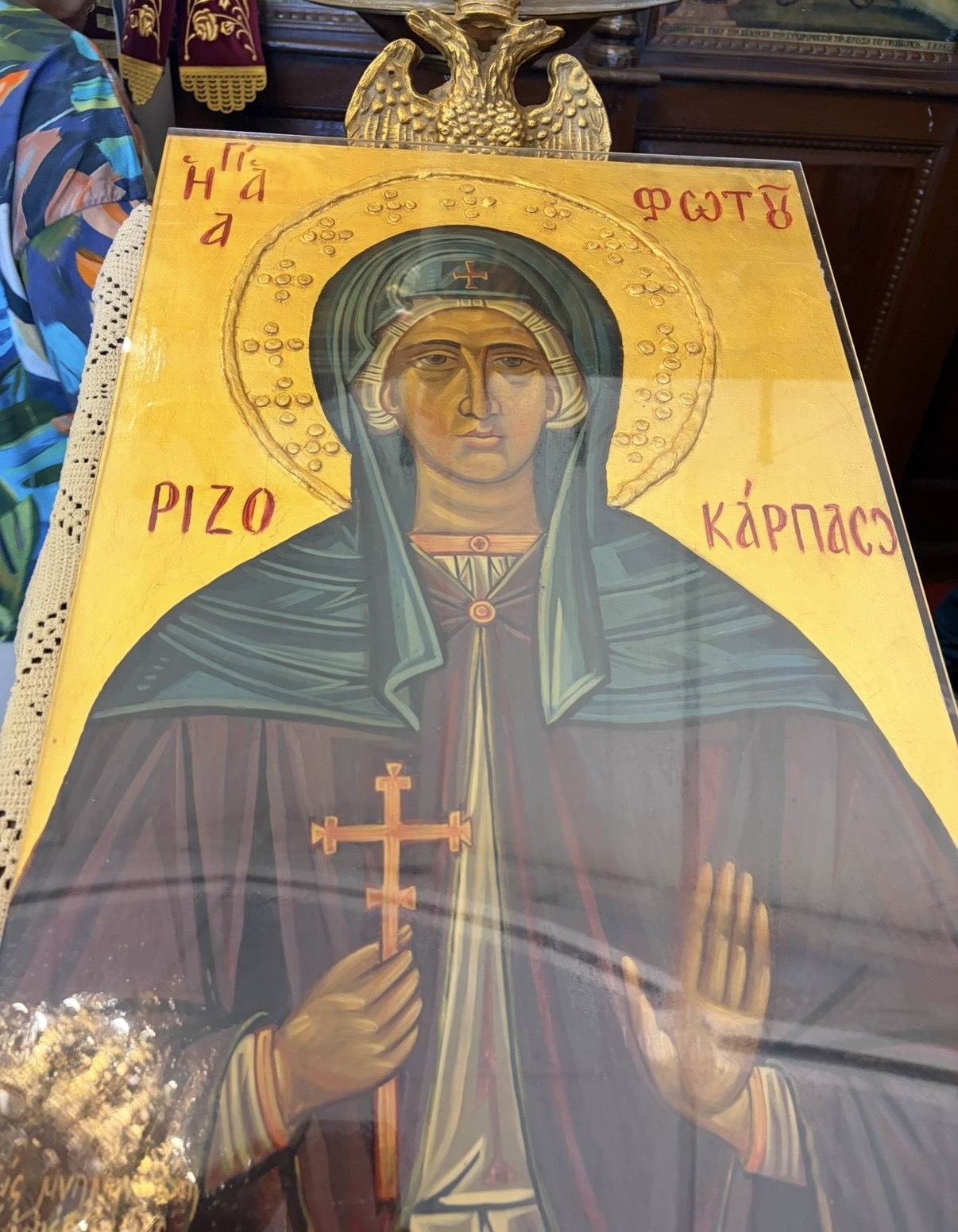
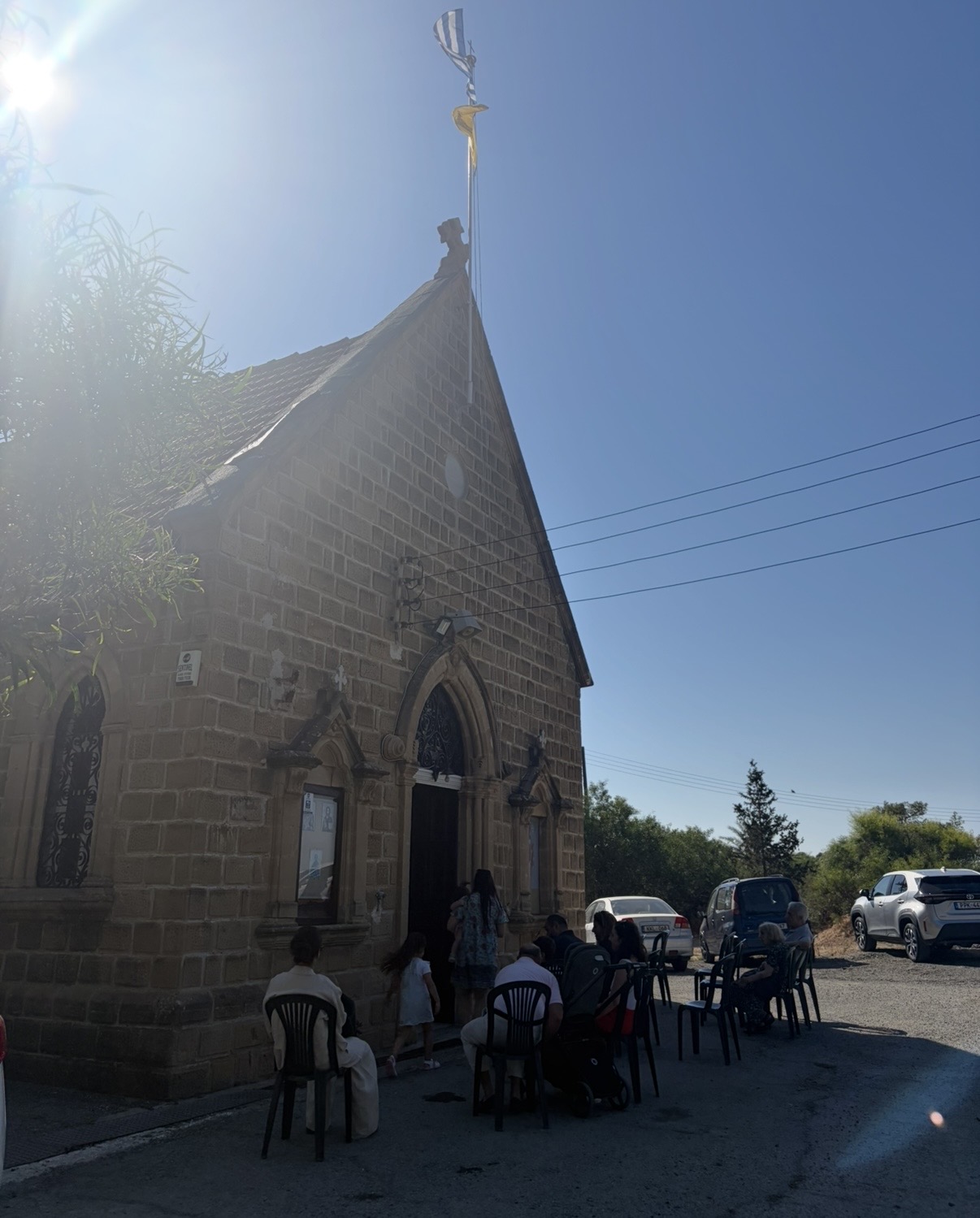
Φωτογραφίες: SkalaTimes (σημερινές από ‘Αγιο Χαράλαμπο στη Λάρνακα)
Κείμενο: https://immorfou.org.cy
Η αγία Φωτεινή (Φωτού) η Κυπρία (2/8)
Ἀνάμεσα στὸ πλῆθος τῶν ὁσιακῶν μορφῶν, ποὺ μὲ τοὺς ἀσκητικοὺς ἱδρῶτες, τὰ ρεύματα τῶν δακρύων τῆς κατανύξεως καὶ τοὺς λοιποὺς θεοφιλεῖς καμάτους τους ἄρδευσαν καὶ ἁγίασαν, ἀπ’ ἄκρη σ’ ἄκρη, τὴ φιλάγια τῆς Κύπρου γῆ, εἶναι γνωστὴ καὶ μία μικρὴ σὲ ἀριθμὸ ὁμάδα ἁγίων γυναικῶν.
Καὶ γι’ αὐτὲς πάλιν ἐλάχιστα κατὰ κανόνα εἶναι τὰ βιογραφικὰ στοιχεῖα, ποὺ ἔφθασαν μέχρις ἐμᾶς, ὅσα, Προνοίᾳ Θεοῦ, διασώθηκαν ἀπὸ τὸν πανδαμάτορα χρόνο καὶ τὶς ποικίλες ἱστορικὲς περιπέτειες τοῦ πολύπαθου νησιοῦ μας.
Ξεχωριστὴ θέση ἀνάμεσά τους, μὲ μιὰ παγκύπρια τιμὴ καὶ ἀκτινοβολία, κατέχει ἀναμφίβολα ἡ ἁγία Φωτεινὴ ἡ Καρπασίτιδα, ἡ γνωστὴ στὸν λαὸ καὶ ὡς ἁγία Φωτοῦ¹, ποὺ ἔζησε κατὰ τὴν πρώιμη μᾶλλον βυζαντινὴ ἐποχή², ἀλλὰ δυστυχῶς δὲν γνωρίζουμε σήμερα τὰ σχετικὰ μὲ τὸν βίο της.
Σύμφωνα μὲ τοπικὴ παράδοση, ἡ φωτώνυμη αὐτὴ ὁσία καταγόταν ἀπὸ τὴν ἀρχαία πόλη τοῦ Καρπασίου. Αὐτό, ποὺ μὲ βεβαιότητα γνωρίζουμε, εἶναι ὅτι διῆλθε τὸν ἀσκητικό της βίο σ’ ἕνα εὐρύχωρο λαξευτὸ ὑπόγειο σπήλαιο μέσα στὸ σημερινὸ χωριὸ Ἅγιος Ἀνδρόνικος Καρπασίας. Τὸ σπήλαιο τοῦτο, ποὺ διατηρεῖται σὲ ἐξαίρετη γενικὰ κατάσταση μέχρι καὶ τὶς μέρες μας, εἶναι πιθανὸν νὰ προϋπῆρξε τῆς ἁγίας Φωτεινῆς, καὶ ἴσως παραπέμπει σὲ πρωτοχριστιανικοὺς ἢ καὶ πρωτοβυζαντινοὺς χρόνους. Σ’ αὐτὸ ὑπάρχουν ἐσωτερικὲς προεκτάσεις, ὑπὸ μορφὴ σηράγγων, διασώζονται δὲ καὶ λαξευμένες ἐσοχὲς στὰ τοιχώματα γιὰ τὴν τοποθέτηση λύχνων.
Ἀξίζει στὴ συνάφεια αὐτὴ νὰ τονισθεῖ πὼς τὸ ἀσκητήριο-σπήλαιο τῆς Ἁγίας Φωτεινῆς δὲν ἀποτελεῖ μεμονωμένο χῶρο ἢ γεγονός, ἀλλὰ ἐντάσσεται σὲ σύμπλεγμα ἀσκητηρίων τῆς εὐρύτερης ἐκεῖ περιοχῆς. Σ’ αὐτὰ περιλαμβάνονται οἱ γνωστοὶ βυζαντινοὶ ναοὶ τῆς Ἁγίας Σολομονῆς ἔξω ἀπὸ τὴν Κώμα τοῦ Γιαλοῦ (9ου αἰώνα), τῆς Ἁγίας Παύλης στὴν Ἁγία Τριάδα Γιαλούσας, τῆς Ἁγίας Θέκλης στὴ Γιαλοῦσα, καὶ τῆς Ἁγίας Βαρβάρας πλησίον τῆς Κορόβειας (8ου αἰώνα). Κάτω ἀπὸ τοὺς τρεῖς πρώτους αὐτοὺς ναοὺς ὑπάρχουν λαξευτοὶ ταφικοὶ θάλαμοι μὲ ἀρκοσόλια3, ἐνῶ πλησίον τοῦ τελευταίου (τῆς Ἁγίας Βαρβάρας) εὑρίσκονται λαξευτὰ σπήλαια, ποὺ λειτούργησαν ὡς ἀσκητήρια, ἐνδεικτικὰ πιθανώτατα τῆς κατὰ τὴ μεσοβυζαντινὴ τουλάχιστον περίοδο ἀκμῆς στὴν περιοχὴ τοῦ γυναικείου μοναχισμοῦ, ἐὰν κρίνουμε ἀπὸ τὴν ἀφιέρωση τῶν ὡς ἄνω ναῶν σὲ γυναῖκες ἁγίες.
Στὸ πιὸ πάνω λοιπὸν σπήλαιο στὸ χωριὸ Ἅγιος Ἀνδρόνικος ἀγωνίσθηκε ἀσκητικὰ ἡ ὁσία Φωτεινὴ μὲ νηστεία, ἀγρυπνία, προσευχή, ἁγνότητα, ταπεινοφροσύνη, ὑπομονὴ καὶ τὶς ἄλλες εὐαγγελικὲς ἀρετές, μὲ τὶς ὁποῖες κατέστη πάμφωτο σκεῦος Θεοῦ, δοχεῖο τῶν χαρισμάτων τοῦ Ἁγίου Πνεύματος, φωτοφόρα καὶ φωτόμορφη. Κατάμεστη λοιπὸν τῶν καρπῶν τῆς ἁγιότητας, κοιμήθηκε ἐν Κυρίῳ καὶ τάφηκε στὸ ἀσκητήριό της. Ὁ τάφος της, ποὺ βρίσκεται στὸ δυτικὸ μέρος τοῦ σπηλαίου, παρέμεινε γιὰ αἰῶνες ἀγνοημένος.
Γιὰ πρώτη φορὰ ἐντοπίσθηκε μετὰ ἀπὸ θεία ἀποκάλυψη κατὰ τὸ πρῶτο μισὸ τοῦ 15ου αἰώνα, σύμφωνα μὲ τὴ σύγχρονη μαρτυρία τοῦ γνωστοῦ Κυπρίου μεσαιωνικοῦ χρονογράφου Λεοντίου Μαχαιρᾶ. Τοῦτο ἦταν ἀσφαλῶς οἰκονομία Θεοῦ, γιὰ νὰ παρηγορήσει τοὺς ὑπόδουλους τότε στοὺς Φράγκους παπικοὺς κατακτητὲς Κυπρίους καὶ νὰ τοὺς στηρίξει στὴν Ὀρθόδοξη πίστη. Ἡ ἀναφορὰ αὐτὴ τοῦ Μαχαιρᾶ, ποὺ ἀποτελεῖ καὶ τὴν ἀρχαιότερη γνωστὴ γραπτὴ μαρτυρία γιὰ τὴν ὁσία Φωτεινή, ἔχει ὡς ἑξῆς (ἀποδίδουμε τὸ κείμενο σὲ μετάφραση, θέτοντας σὲ παρένθεση ἐπεξηγηματικὲς-διασαφηνιστικὲς λέξεις/φράσεις):
«Ἀκόμη βρίσκεται στὴν (περιοχὴ) Ἀκρωτίκη, στὴν κώμη τοῦ Ἁγίου Ἀνδρονίκου τῆ ςΚανακαριᾶς—ἔχει λίγο καιρὸ καὶ βρέθηκε μὲ ἀποκάλυψη Θεοῦ— (μία ἄλλη ἁγία), ποὺ τὴν ὀνομάζουν ἁγία Φωτεινή, καὶ ὁ τάφος της εἶναι κάτω ἀπὸ τὴ γῆ (σὲ σπήλαιο). (Ἐκεῖ) ὑπάρχει (ἅγιο) Βῆμα καὶ τελεῖται ἡ Θεία Λειτουργία. Ἐπίσης ἐκεῖ ὑπάρχει νερὸ-ἁγίασμα, καὶ (στὸ πηγάδι ποὺ βρίσκεται) ἔχει πολὺ βάθος τὸ νερό, καὶ στὸ γύρισμα τοῦ φεγγαριοῦ πήζει ἐπάνω τὸ νερὸ (ἁγίασμα), ὅπως πήζει ὁ πάγος, καὶ γίνεται μία τσίππα. Καὶ τὴ βγάζουν (ἀπὸ τὸ πηγάδι) σὰν μιὰ πλάκα πάγου. Κι ἅμα ἀρχίζει νὰ λυώνει, γίνεται λεπτὸ σὰν σκόνη, καὶ τὴ βάζουν στὰ μάτια τους οἱ τυφλοὶ καὶ θεραπεύονται»4.
Ἔκτοτε ἡ ἁγία Φωτεινή, καὶ μέχρι τὶς μέρες μας, ἐνεργεῖ πλεῖστα ὅσα θαύματα σ’ αὐτοὺς ποὺ μὲ πίστη προσέρχονται καὶ προσεύχονται σ’ αὐτήν. Κατ’ ἐξαίρεση ἔλαβε, κατὰ τὴν ἐπωνυμία της, τὴ Χάρη τῆς θεραπείας τῶν ποικίλων ὀφθαλμικῶν παθήσεων, μάλιστα τῶν τυφλώσεων, χορηγώντας ἄφθονα τὶς ἰάσεις μὲ τὸ νερὸ τοῦ ἁγιάσματός της5. Τὸ πηγάδι τοῦ περιωνύμου αὐτοῦ ἁγιάσματος, πού, ὅπως εἴδαμε, ἀναφέρει καὶ ὁ Λεόντιος Μαχαιρᾶς, βρίσκεται στὸ ἄκρο λαξευμένης πρὸς τὰ βόρεια τοῦ σπηλαίου σήραγγας. Σύμφωνα μὲ ἔγκυρες πληροφορίες, τὸ ἁγίασμα αὐτὸ στέρεψε τὸ 1974, μετὰ τὴν τουρκικὴ εἰσβολή, ἕνεκα τῆς βεβήλωσης τοῦ χώρου ἀπὸ τοὺς Τούρκους.
Πέραν τῆς μαρτυρουμένης χρήσης τοῦ σπηλαίου τούτου ὡς ναοῦ ἤδη ἀπὸ τὴν περίοδο τῆς Φραγκοκρατίας, ἀλλὰ καὶ μέχρι πρόσφατα (τὸ ἔτος 1974), ὁ χῶρος αὐτὸς λειτούργησε πιθανώτατα καὶ ὡς Μονή. Ἀργότερα (ἴσως ἐπὶ τουρκοκρατίας) λειτούργησε ἐπάνω καὶ πέριξ τοῦ σπηλαίου μικρὴ ἀνδρώα Μονή, ποὺ διαλύθηκε περὶ τὸ τέλος τοῦ 19ου αἰώνα6. Ὁ ναός, ποὺ βρίσκεται σήμερα πάνω ἀπὸ τὸ σπήλαιο, κτίσθηκε ἐπὶ ἀρχιεπισκόπου Κύπρου Χρυσάνθου (1767-1810), λειτουργοῦσε δὲ πρὸ τῆς εἰσβολῆς ὡς ὁ ἐνοριακὸς ναὸς τοῦ χωριοῦ Ἅγιος Ἀνδρόνικος7.
Ἐξαιτίας τῶν ποικίλων ἱστορικῶν τῆς Κύπρου περιστάσεων, ὁ τάφος τῆς ὁσίας προφανῶς καλύφθηκε καὶ πάλιν μετὰ τὴν ἀνωτέρω εὕρεσή του, πρὸς ἀποφυγὴ σύλησης τοῦ ἱεροῦ της λειψάνου, καὶ μὲ τὰ χρόνια καὶ πάλιν λησμονήθηκε. Γιὰ δεύτερη φορὰ ἀνευρέθη ἐπὶ ἀρχιεπισκόπου Κύπρου Σιλβέστρου (1718-1733) ἀπὸ τὸν τότε ἐπιστάτη τῆς Μονῆς τῆς Ὁσίας, οἰκονόμο Ἄνθιμο. Ἐπιθυμώντας δηλαδὴ αὐτὸς νὰ εὐρυχωρήσει τὸ σπήλαιο, ἔσκαψε πρὸς τὰ δυτικά, ὅπου βρῆκε ξανὰ τὸν τάφο καὶ τὸ ἱερὸ λείψανο τῆς ἁγίας, πάνω στὸ ὁποῖο ὑπῆρχε μαρμάρινος σταυρός, ποὺ ἔφερε τὴν ἐπιγραφή, «Φωτεινὴ ὁσία, νύμφη Χριστοῦ». Τοῦτο ὑπῆρξε καὶ πάλιν ἔργο τῆς Πρόνοιας τοῦ Θεοῦ, γιὰ τὴ στήριξη τοῦ τουρκοκρατουμένου καὶ δεινοπαθοῦντος πιστοῦ λαοῦ τῆς Κύπρου. Ἀφοῦ τότε εἰδοποιήθηκε σχετικὰ ὁ ἀρχιεπίσκοπος Σίλβεστρος, πρόσταξε καὶ ἀσφάλισαν τὸ ἅγιο λείψανο μέσα στὸν τάφο. Ἀργότερα ἀνακομίσθησαν ἀπὸ ἐκεῖ τὰ ἱερὰ αὐτὰ λείψανα, κατὰ δὲ τὸ 1974 μετακομίσθηκαν στὴν ἱερὰ ἀρχιεπισκοπὴ Κύπρου.
Ναοὶ ἐπ’ ὀνόματι τῆς Ἁγίας Φωτεινῆς βρίσκονται καὶ σὲ ἄλλα μέρη τῆς Κύπρου, ἀλλὰ δὲν εἶναι γνωστὸ ἐὰν ἐτιμᾶτο ἐκεῖ ἀρχικὰ ἡ Κυπρία ὁσία, ἡ Καρπασίτιδα ἢ ἡ ὁμώνυμη Μεγαλομάρτυς, ἡ Σαμαρείτιδα. Πιθανώτατα ὅμως στοὺς παλαιοὺς ναοὺς στὴν Ἀμμόχωστο καὶ τὸν Γερόλακκο νὰ ἐτιμᾶτο ἡ Κυπρία Φωτεινή, ὅπως καὶ στὸ (μεταγενεστέρως τουρκοκυπριακὸ) χωριὸ Φῶττα (ἢ Φότα), ποὺ ἀρχικὰ ἐκαλεῖτο Ἁγία Φωτεινή, μετονομάσθηκε δὲ ἔτσι ἀπὸ τοὺς Τουρκοκυπρίους8.
Παλαιότερη γνωστὴ φορητὴ εἰκόνα τῆς ὁσίας εἶναι μία τοῦ ἔτους 1811, ἔργο τοῦ γνωστοῦ ζωγράφου ἱερομονάχου Λαυρεντίου, ποὺ κλάπηκε κατὰ τὴν εἰσβολὴ ἀπὸ τοὺς Τούρκους καὶ πωλήθηκε στὴν Εὐρώπη9. Αὐτή, ὅπως καὶ οἱ σωζόμενες νεώτερες εἰκόνες, παριστοῦν τὴν ἁγία μὲ μοναχικὴ ἐνδυμασία καὶ νὰ φέρει στὸ δεξί της χέρι Σταυρό.
Ἡ μνήμη τῆς ἁγίας Φωτεινῆς ἑορτάζεται στὶς 2 Αὐγούστου10, ἡμέρα κατὰ τὴν ὁποία, μέχρι καὶ πρὶν τὴν τουρκικὴ εἰσβολή τοῦ 1974, ἐτελεῖτο μεγάλη πανήγυρη στὸ χωριὸ Ἅγιος Ἀνδρόνικος Καρπασίας, στὴν ὁποία μετέβαινε κατὰ κανόνα καὶ ὁ ἑκάστοτε ἀρχιεπίσκοπος Κύπρου11.
Ταῖς τῆς φωτοφόρου καὶ φωτωνύμου ὁσίας ἁγίαις πρεσβείαις, ὁ Θεός, φώτισον καὶ ἡμῶν τὰ ὄμματα τῆς ψυχῆς καὶ τοῦ σώματος, καὶ ἐλέησον ἡμᾶς, ὡς μόνος Οἰκτίρμων. Ἀμήν!
Ἐπισημειώσεις
1. Τὸ ὄνομα τῆς ἁγίας Φωτοῦ παράχθηκε ἀπὸ τὴ γενικὴ τοῦ συγγενικοῦ ὀνόματος τῆς ἁγίας, ἡ Φωτὼ (τῆς Φωτοῦς), ἀποτελεῖ δὲ σύνηθες γλωσσικὸ φαινόμενο ἀναγόμενο στὴ βυζαντινὴ ἐποχὴ (τῆς ἀποδόσεως δηλ. θηλυκῶν κυρίων προσηγορικῶν ὀνομάτων εἰς -οῦ, π.χ. Σωφρονοῦ, Κυριακοῦ, Παρασκευοῦ κ.λπ.).
2. Ὄχι μόνο ὁ χῶρος ἀσκήσεως τῆς ὁσίας, ἀλλὰ καὶ ὁ τύπος τοῦ τάφου της, πού, παρὰ τὶς μεταγενέστερες ἐπεμβάσεις (κατὰ τὶς δύο ἀνευρέσεις του), διακρίνεται ἐμφανῶς ὅτι ἦταν ἀρκοσόλιο (βλ. ἑπόμενη σημ.), παραπέμπουν στὴν παλαιοχριστιανικὴ περίοδο.
3. Ἡ λ. ἀρκοσόλιο (ἀπὸ τὸ λατινικὸ arcosolium, προερχόμενο ἀπὸ τὶς λ. arcus=τόξο καὶ solium=σορός, θήκη, τάφος), δηλώνει τοὺς τοξωτοὺς τάφους, ποὺ κατασκευάζονταν κατὰ τὴ ρωμαϊκὴ-παλαιοχριστιανικὴ περίοδο. Ὁ τάφος τοῦ τύπου τούτου, ποὺ προεξεῖχε λίγο ἀπὸ τὸ δάπεδο, ἐπιστεγαζόταν ἀπὸ τοξωτὴ ὀροφή, δίνοντας ἔτσι ἕνα πλαστικὸ βάθος στὴν κατασκευή. Τὰ ἀρκοσόλια τῶν Ἁγίων διακοσμοῦνταν συνήθως μὲ ποικίλες παραστάσεις (νωπογραφίες).
4. Λεοντίου Μαχαιρᾶ, Χρονικόν, στό: R. M. Dawkins (ἐπιμ.), Leontios Makhairas, Recital concerning the Sweet Land of Cyprus entitled ‘Chronicle’, Ὀξφόρδη 1932, τόμ. I, §34, σσ. 32-35. Τὰ τοῦ Μαχαιρᾶ περιληπτικὰ ἀναφέρουν καὶ οἱ D. Strambaldi (Chronicha, σ. 14), Fl. Bustron (Historia, σ. 34) καὶ ἀρχιμανδρίτης Κυπριανὸς (Ἱστορία χρονολογική, σ. 352).
5. Ἡ καὶ ἀπὸ τὸ ὄνομα τῆς ὁσίας Φωτεινῆς ἀπορρέουσα θαυματουργικὴ Χάρη τῆς θεραπείας τῶν ὀφθαλμικῶν παθήσεων ἔχει ἀντίστοιχη περίπτωση τὰ μετὰ θάνατον θαύματα τῆς ὁμώνυμης μεγαλομάρτυρος Φωτεινῆς τῆς Σαμαρείτιδος στὴν Κωνσταντινούπολη, ὅπου μάλιστα ὑπῆρχε καὶ ἁγίασμα, θεραπευτικὸ τῶν ἀσθενειῶν (βλ. «Ἡ εὕρεσις τῶν λειψάνων τῆς ἁγίας μεγαλομάρτυρος Φωτεινῆς καὶ μερικὴ ταύτης θαυμάτων ἐξήγησις», στό: Fr. Halkin, Hagiographica Inedita Decem, Corpus Christianorum Series Graeca, No. 21, Louvain 1989, σσ. 111-125 [κείμενο], καὶ σχετικὰ σχόλια στό: Alice-Mary Talbot, «The posthumous miracles of St. Photeine», Analecta Bollandiana, 112 [1994], σσ. 85-104).
6. Γιὰ τὴ μικρὴ αὐτὴ Μονὴ τῆς Ὁσίας βλ. στό: Ν. Γ. Κυριαζῆς, Τὰ Μοναστήρια ἐν Κύπρῳ, Λάρνακα 1950, σ. 99 καί, Κωστῆς Κοκκινόφτας-Θεοχαρίδης Ἰωάννης, «Μοναστηριακὰ δεδομένα σύμφωνα μὲ τὸ Κατάστιχο VΙ τῆς ἀρχιεπισκοπῆς Κύπρου (1825)», Ἐπετηρίδα Κέντρου Μελετῶν Ἱ. Μ. Κύκκου, 4, σσ. 241-309, μάλιστα Πίν. 1-3 καὶ Χάρτης 3.
7. Σύμφωνα μὲ πληροφορίες τῶν ἐγχωρίων, στὴν τουρκοκυπριακὴ συνοικία (τουρκομαχαλλᾶ) τοῦ Ἁγίου Ἀνδρονίκου, ὑπῆρχε ναὸς τοῦ Ἁγίου Ἀνδρονίκου, ἐρειπωμένος σήμερα.
8. Τοὺς ναοὺς καὶ τὰ ἁγιώνυμα τοπωνύμια στὴν Κύπρο, Ἁγία Φωτεινὴ καὶ Ἁγία Φωτοῦ, βλ. στά: Christodoulou Menelaos and Konstantinides Konstantinos, A complete Gazetteer of Cyprus, τόμ. I, Λευκωσία 1987, σ. 20, καὶ Jack Goodwin, An Historical Toponymy of Cyprus, τόμ. I, Λευκωσία 51985, σ. 299. Ἂς σημειωθεῖ πὼς ὁ ναὸς τῆς Ὁσίας στὴν Ἀκανθοῦ (19ου[;] αἰ.) ἦταν ὁ κοιμητηριακὸς τοῦ χωριοῦ, ὑπῆρχε δὲ παλαιότερα ναός της καὶ στὴν Κυθρέα.
9. Ἡ εἰκόνα αὐτὴ τῆς ὁσίας, μαζὶ μὲ ἄλλες εἰκόνες ἀπὸ τὴν Κύπρο, κλεμμένες μετὰ τὴν εἰσβολὴ ἀπὸ Τούρκους ἐμπόρους ἀρχαιοτήτων, παρουσιάσθηκαν σὲ ἔκθεση στὴ Γερμανία καὶ τιτλοφορήθηκαν ὡς προερχόμενες ἀπὸ τὸ Ἅγιον Ὄρος (!), μετὰ δὲ ἐξαφανίσθηκαν (βλ. Κατάλογο τῆς Ἐκθέσεως, Ikonen des Ostens. Kultbilder aus fünf Jahrhunderten, St. Otto-Verlag Bemberg, Germany, No. 30, σ. 124, «Heilige Fotinia»).
10. Παλαιότερη σωζόμενη Ἀκολουθία τῆς ὁσίας, ποὺ ἀσφαλῶς σχετίζεται μὲ τὴν ἐπὶ ἀρχιεπισκόπου Σιλβέστρου ἐπανεύρεση τοῦ ἱεροῦ λειψάνου της, εἶναι ἡ συμπιληθεῖσα ἀπὸ τὸν μοναχὸ Ἀκάκιο στὸ γνωστό του χγφ. Πεντέορτον (1732/1733), ποὺ δημοσιεύθηκε στό: Κυπριακαὶ Σπουδαί, ΙΑ΄ (1947), σσ. 77-97, μὲ σχετικὰ προλεγόμενα στὶς σσ. κη΄-κθ΄ (τὸ Συναξάριο εἶχε προδημοσιευθεῖ ἀπὸ τὸν Ἰω. Συκουτρῆ στὰ Κυπριακὰ Χρονικά, Β΄ [1924], σσ. 238-240). Ἡ αὐτὴ σχεδὸν Ἀκολουθία (μὲ μικρὲς διαφορὲς) βρίσκεται στὸ γραμμένο ἀπὸ τὸν Ἀντώνιο Τεϊρμεντζόγλου χγφ. Ἱ. Μητροπόλεως Κιτίου 25 (ἀρχῶν τοῦ 19ου αἰ.), σσ. 246-287. Ἀμφότερες στεροῦνται ὁποιασδήποτε πρωτοτυπίας (ὡς καὶ οἱ μεταγενέστερες ὑπὸ τῶν Μαχαιριωτῶν Ἰγνατίου [1881] καὶ Μητροφάνους [1899]). Ἰδιαίτερο ἐνδιαφέρον παρουσιάζει τὸ Συναξάριό τους, ποὺ στὸν Τεϊρμεντζόγλου ἀποδίδεται μὲ διαφορές, ἀλλὰ περιέχει τὰ αὐτὰ βασικὰ στοιχεῖα. Ἀξιοσημείωτο ὅτι σ’ αὐτὸ (τοῦ Τεϊρμεντζόγλου) γίνεται τὸ πρῶτον ἀναφορὰ στὴν ἐπὶ Σιλβέστρου ἀνεύρεση τοῦ λειψάνου τῆς ὁσίας —στὸν Ἀκάκιο ὑπονοεῖται, ἀλλὰ δὲν ἀναφέρεται ρητὰ— ἀπὸ τὸν οἰκονόμο Ἄνθιμο (καὶ ὄχι Νικόδημο, ὅπως βραδύτερα ἐπεκράτησε), καὶ ὅτι τότε (περίπου τέλη 18ου/ἀρχὲς 19ου αἰ.) τὸ λείψανο βρισκόταν ἀκέραιο μέσα στὸν τάφο. Νέα ᾀσματικὴ Ἀκολουθία, ποίημα τοῦ Ὑμνογράφου Χαραλάμπους Μπούσια, περιλήφθηκε (μαζὶ μὲ τὴ σχετικὴ βιβλιογραφία) στὰ Κύπρια Μηναῖα, Ι΄ (Αὔγουστος), σσ. 21-38.
11. Ὡς γνωστό, μὲ τὴν Bulla Cypria τοῦ πάπα Ἀλεξάνδρου Δ΄ (1260) καταργήθηκε ὁ τίτλος καὶ θεσμὸς τοῦ ἀρχιεπισκόπου Κύπρου, οἱ δὲ ἐπισκοπὲς τῆς νήσου περιορίσθηκαν ἀπὸ 14 σὲ 4. Μεταξὺ τῶν ἐπισκοπῶν αὐτῶν ποὺ καταργήθηκαν ἦταν καὶ αὐτὴ τοῦ Καρπασίου, ὅπου ἐξορίσθηκε ὁ ἐπίσκοπος Κωνσταντίας-Ἀμμοχώστου. Μὲ τὴν ἀνασύσταση τῆς Ὀρθόδοξης Ἐκκλησίας Κύπρου μετὰ τὴν κατάληψη τῆς νήσου ἀπὸ τοὺς Τούρκους (1570/1571), ἡ ἐπισκοπὴ Καρπασίου (καθὼς καὶ ἡ τῆς Ἀμμοχώστου) περιέρχεται ὑπὸ τὴ δικαιοδοσία τοῦ ἀρχιεπισκοπικοῦ θρόνου. Πρόσφατα (2007), μὲ τὴ διεύρυνση τῆς Ἱερᾶς Συνόδου τῆς Ἐκκλησίας Κύπρου, ἀνασυνεστήθη ἡ ἐπισκοπὴ Καρπασίου καὶ ἐξελέγη καὶ χωρεπίσκοπος Καρπασίας ὁ κ. Χριστοφόρος.
Πηγή: https://immorfou.org.cy/%CE%B7-%CE%B1%CE%B3%CE%AF%CE%B1-%CF%86%CF%89%CF%84%CE%B5%CE%B9%CE%BD%CE%AE-%CF%86%CF%89%CF%84%CE%BF%CF%8D-%CE%B7-%CE%BA%CF%85%CF%80%CF%81%CE%AF%CE%B1-2-8/
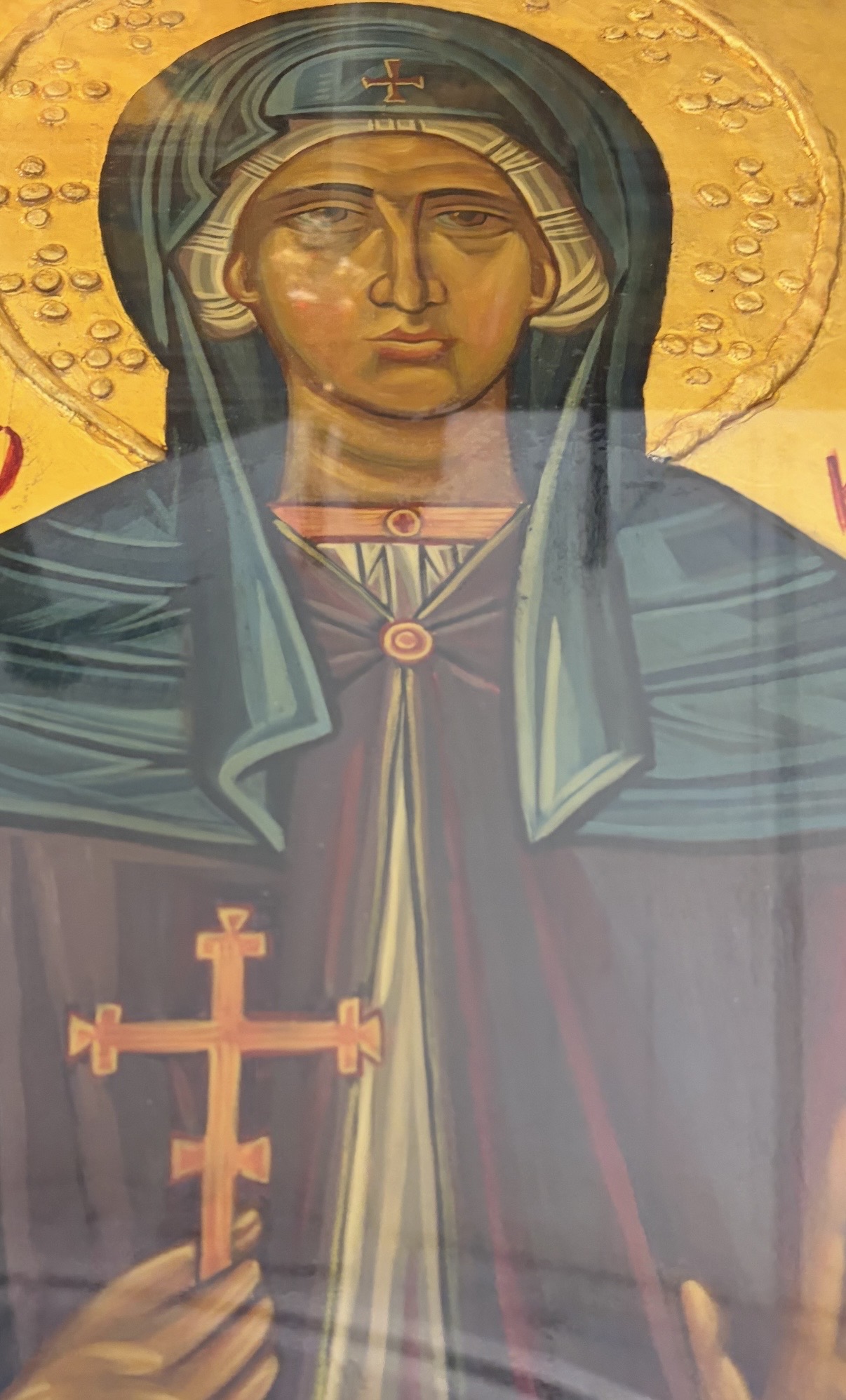
Photos: SkalaTimes (taken today at the Church of Saint Charalambos, Larnaca)
Text: Holy Metropolis of Morphou
Saint Photini (Photou) the Cypriot (August 2)
Among the multitude of holy ascetics who, through the sweat of their spiritual struggles, the streams of their tears of compunction, and their many other God-pleasing labors, watered and sanctified the beloved land of Cyprus from one end to the other, there is also known a small group of holy women.
As is generally the case with them, only very few biographical details have survived to our day—only those which, by God’s Providence, were preserved through the ravages of time and the many historical trials endured by our long-suffering island.
Holding a distinguished place among them, and honored throughout all of Cyprus, is Saint Photini of Karpasia, known among the people as Saint Photou, who most likely lived during the early Byzantine period. Unfortunately, however, nothing certain is known today concerning the details of her earthly life.
According to local tradition, this God-bearing ascetic originated from the ancient city of Karpasia. What we do know with certainty is that she spent her ascetic life in a spacious rock-cut underground cave located within the present-day village of Agios Andronikos in the Karpasia peninsula. This cave, which has survived in remarkably good condition to the present day, most likely predates Saint Photini herself and may even date back to the Early Christian or Early Byzantine period. Inside are passages extending deeper into the rock in the form of tunnels, while niches carved into the walls for the placement of oil lamps are still preserved.
It is worth emphasizing that Saint Photini’s cave-hermitage was not an isolated phenomenon but formed part of a wider complex of ascetic sites throughout the surrounding region. These include the Byzantine churches of Saint Solomoni outside Koma tou Gialou (9th century), Saint Paula at Agia Triada of Yialousa, Saint Thekla at Yialousa, and Saint Barbara near Koroveia (8th century). Beneath the first three churches are rock-cut burial chambers containing arcosolia, while near the last-mentioned church of Saint Barbara are carved caves that served as hermitages. These testify, most probably, to the flourishing of female monasticism in the region during at least the Middle Byzantine period, as may be inferred from the dedication of these churches to women saints.
It was therefore within this cave in the village of Agios Andronikos that Saint Photini waged her ascetic struggle through fasting, vigil, prayer, purity, humility, patience, and every other evangelical virtue. By these she became a vessel radiant with divine light, a chosen instrument of God, a receptacle of the gifts of the Holy Spirit, filled with heavenly illumination.
Having borne the abundant fruits of holiness, she reposed in the Lord and was buried within her hermitage. Her tomb, situated in the western part of the cave, remained unknown for many centuries.
For the first time, her tomb was discovered following a divine revelation during the first half of the fifteenth century, according to the contemporary testimony of the renowned medieval Cypriot chronicler Leontios Makhairas. This was undoubtedly an act of God’s providence, intended to console the Cypriot people, then living under Frankish Latin rule, and to strengthen them in the Orthodox faith.
Makhairas’ account—the earliest known written testimony concerning Saint Photini—reads as follows (presented here in translation, with explanatory words and phrases inserted in parentheses): “There is also, in the district of Akrotiki, in the village of Saint Andronikos of Kanakaria—discovered only recently through a revelation from God—(another holy woman) whom they call Saint Photini. Her tomb lies beneath the earth (inside a cave). There is a holy sanctuary there, and the Divine Liturgy is celebrated. There is also holy water there, and the well is exceedingly deep. At the turning of the moon, the water on its surface becomes solid, as though frozen into ice, forming a thin crust. This is lifted out like a slab of ice; and when it begins to melt, it turns into a fine powder. Those who are blind apply it to their eyes and are healed.”
From that time until the present day, Saint Photini has continued to work countless miracles for those who approach her with faith and prayer. In keeping with her very name—Photini, meaning “the enlightened” or “the radiant”—she was granted, by the grace of God, the special gift of healing diseases of the eyes, especially blindness. Through the holy water of her sanctuary she bestowed abundant cures upon the afflicted.
The celebrated holy spring mentioned by Leontios Makhairas is situated at the end of a tunnel carved into the northern side of the cave. According to reliable testimony, however, the spring dried up in 1974 following the Turkish invasion of Cyprus, after the sanctuary itself was desecrated by the occupying forces.
Apart from serving as a church from at least the period of Frankish rule until as recently as 1974, the cave also appears to have functioned as a monastery. Later—perhaps during the Ottoman period—a small men’s monastery was established above and around the cave. It remained active until approximately the end of the nineteenth century.
The church standing above the cave today was built during the episcopate of Archbishop Chrysanthos of Cyprus (1767–1810). Until the Turkish invasion of 1974, it served as the parish church of the village of Agios Andronikos.
Owing to the many turbulent periods of Cypriot history, Saint Photini’s tomb was evidently concealed once again after its first discovery in order to protect her sacred relics from desecration. In the course of time its location was forgotten once more.
It was rediscovered for a second time during the archiepiscopate of Archbishop Sylvester of Cyprus (1718–1733) by the steward of the monastery, Oikonomos Anthimos. Wishing to enlarge the cave, Anthimos excavated toward the west and uncovered once again the saint’s tomb and holy relics. Resting upon them was a marble cross bearing the inscription: “Photini the Venerable, Bride of Christ.”
This second discovery was likewise an act of Divine Providence, strengthening the faithful people of Cyprus during the hardships of Ottoman rule. After Archbishop Sylvester was informed, he ordered that the holy relics be reverently secured within the tomb. At a later time they were translated from the cave, and in 1974, following the Turkish invasion, they were transferred for safekeeping to the Holy Archbishopric of Cyprus.
Churches dedicated to Saint Photini are also found in other parts of Cyprus. It is not always clear, however, whether these were originally dedicated to Saint Photini the Cypriot of Karpasia or to her more widely known namesake, Saint Photini the Samaritan Woman and Great Martyr. It is quite possible that the older churches at Famagusta and Gerolakkos were originally dedicated to the Cypriot saint. The same is likely true of the village later known as the Turkish Cypriot settlement of Photta (or Fota), which was originally called Agia Photini before being renamed by the Turkish Cypriots.
The oldest known portable icon of Saint Photini dates from 1811 and was painted by the well-known hieromonk and iconographer Laurentios. During the Turkish invasion of 1974, the icon was stolen and subsequently sold in Europe. Like the surviving later icons, it depicts the saint clothed in monastic garments, holding a cross in her right hand as a sign of her complete dedication to Christ.
The feast of Saint Photini is celebrated on 2 August. Until the Turkish invasion of 1974, a great annual festival was held on this day at the village of Agios Andronikos in Karpasia, attracting pilgrims from throughout Cyprus. As a rule, the Archbishop of Cyprus himself would attend the celebration.
May God, through the holy intercessions of the radiant and light-bearing Venerable Mother Saint Photini, illumine the eyes of both our souls and our bodies, and have mercy upon us, for He alone is compassionate.
Amen.
Notes
1.
The popular name Photou derives from the genitive form of the familiar name Photō (της Φωτούς). This is a common linguistic phenomenon dating back to the Byzantine period, whereby feminine proper names came to be used in the genitive form ending in -ou, as in Sophronou, Kyriakou, Paraskevou, and others.
2.
Not only the saint’s place of ascetic struggle, but also the form of her tomb—which, despite later alterations following its two rediscoveries, can clearly be identified as an arcosolium—points to the Early Christian period.
3.
An arcosolium (from the Latin arcus = arch and solium = sarcophagus, burial chamber, or tomb) is an arched burial niche commonly constructed during the Roman and Early Christian periods. Such tombs projected slightly above the floor and were covered by a vaulted arch, giving the structure considerable architectural depth. The arcosolia of saints were often decorated with frescoes depicting sacred subjects.
4.
The account of Saint Photini recorded by Leontios Makhairas is found in:
R. M. Dawkins (ed.), Leontios Makhairas, Recital concerning the Sweet Land of Cyprus entitled “Chronicle”, Oxford, 1932, Vol. I, §34, pp. 32–35.
Brief references to Makhairas’ account also appear in the works of D. Strambaldi (Chronicha, p. 14), Florio Bustron (Historia, p. 34), and Archimandrite Kyprianos (Chronological History, p. 352).
5.
The miraculous grace bestowed upon Saint Photini for the healing of eye diseases is echoed in the posthumous miracles of her namesake, Saint Photini the Samaritan Woman and Great Martyr, whose relics were venerated in Constantinople. There, too, a holy spring (hagiasma) was renowned for curing illnesses, particularly diseases of the eyes.
See:
- “The Discovery of the Relics of Saint Photini the Great Martyr and an Explanation of Some of Her Miracles,” in Fr. François Halkin, Hagiographica Inedita Decem, Corpus Christianorum Series Graeca, No. 21, Louvain, 1989, pp. 111–125.
- Alice-Mary Talbot, “The Posthumous Miracles of St. Photeine,” Analecta Bollandiana, 112 (1994), pp. 85–104.
6.
For information concerning the small monastery dedicated to Saint Photini, see:
- N. G. Kyriazis, The Monasteries of Cyprus, Larnaca, 1950, p. 99.
- Kostis Kokkinoftas and Ioannis Theocharides, “Monastic Records according to Register VI of the Archbishopric of Cyprus (1825),” Yearbook of the Kykkos Monastery Research Centre, Vol. 4, pp. 241–309, especially Tables 1–3 and Map 3.
7.
According to local tradition, within the Turkish Cypriot quarter of Agios Andronikos there once stood a church dedicated to Saint Andronikos, now lying in ruins.
8.
For churches and place names in Cyprus dedicated to Saint Photini or Saint Photou, see:
- Christodoulou Menelaos and Konstantinos Konstantinides, A Complete Gazetteer of Cyprus, Vol. I, Nicosia, 1987, p. 20.
- Jack Goodwin, An Historical Toponymy of Cyprus, Vol. I, 5th ed., Nicosia, 1985, p. 299.
It should also be noted that the church of Saint Photini at Akanthou (probably dating from the nineteenth century) served as the village cemetery church, while an older church dedicated to her once existed at Kythrea.
9.
The icon of Saint Photini painted in 1811, together with other Cypriot icons stolen after the Turkish invasion by antiquities traffickers, was exhibited in Germany under the misleading title that they originated from Mount Athos. After the exhibition, the icons disappeared.
See the exhibition catalogue:
Ikonen des Ostens: Kultbilder aus fünf Jahrhunderten, St. Otto-Verlag, Bamberg, Germany, No. 30, p. 124 (“Heilige Fotinia”).
10.
The earliest surviving liturgical service in honor of Saint Photini, almost certainly connected with the rediscovery of her relics during the time of Archbishop Sylvester, was composed by the monk Akakios in his manuscript Pentéorton (1732/1733).
It was later published in Kypriakai Spoudai, Vol. XI (1947), pp. 77–97, with an introduction on pp. xxviii–xxix. The Synaxarion had previously been published by Ioannis Sykoutris in Kypriaka Chronika, Vol. II (1924), pp. 238–240.
A nearly identical version of the service, with only minor variations, appears in manuscript 25 of the Holy Metropolis of Kition, written by Antonios Teirmentzoglou in the early nineteenth century (pp. 246–287).
Neither version displays significant literary originality, nor do the later services composed by the Machairas monks Ignatios (1881) and Mitrophanes (1899).
The Synaxarion, however, is of particular historical importance. Teirmentzoglou’s version is the first to state explicitly that Saint Photini’s relics were rediscovered during the archiepiscopate of Sylvester by the steward Anthimos (rather than Nikodemos, as later tradition maintained). It also records that, at the close of the eighteenth or beginning of the nineteenth century, the saint’s relics were still preserved intact within her tomb.
A modern liturgical office in honor of Saint Photini, composed by the hymnographer Charalambos Bousias, was later included—together with the relevant bibliography—in the Cypriot Menaion, Vol. X (August), pp. 21–38.
11.
As is well known, the Bulla Cypria issued by Pope Alexander IV in 1260 abolished the title and office of the Orthodox Archbishop of Cyprus, reducing the island’s dioceses from fourteen to four.
Among the dioceses suppressed was that of Karpasia, whose bishop was subsequently transferred to Constantia–Famagusta.
Following the Ottoman conquest of Cyprus (1570–1571) and the restoration of the Orthodox Church, the Diocese of Karpasia, together with that of Famagusta, came under the direct jurisdiction of the Archbishop of Cyprus.
More recently, in 2007, following the expansion of the Holy Synod of the Church of Cyprus, the Diocese of Karpasia was re-established, and Bishop Christophoros was elected as Chorbishop of Karpasia.